


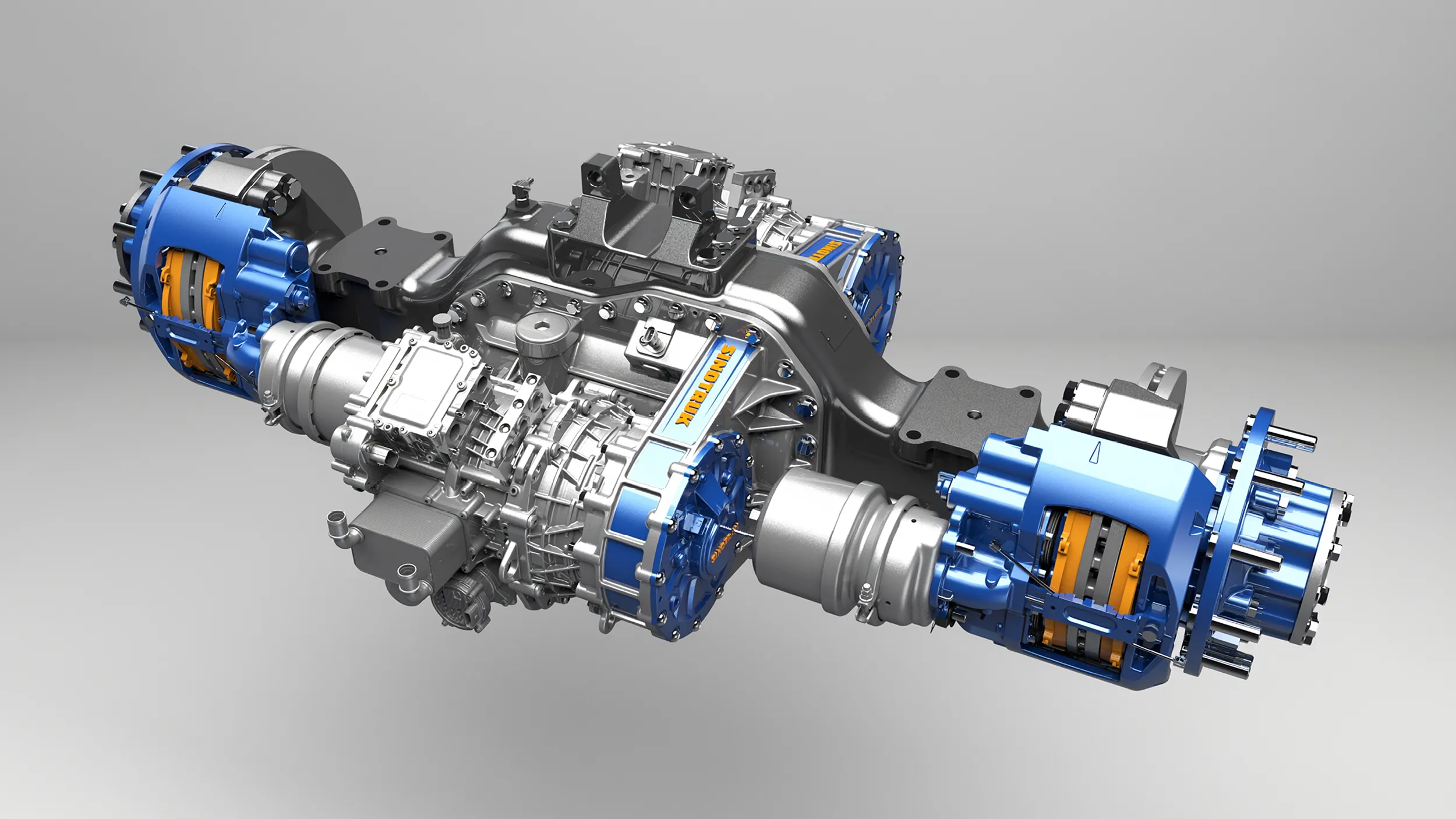
The next-generation MCE12 integrated E-Axle has been engineered for outstanding efficiency, reliability and adaptability across a wide range of operating conditions. Compatible with light- and heavy-duty trucks as well as special-purpose vehicle platforms, it sets a new benchmark for commercial-vehicle electrification.
The oil-cooled hairpin-winding motor, high-ratio reduction gearset and thermal-management module are highly integrated, making the system more than 20% lighter than comparable products and optimising chassis packaging. The one-piece cast axle housing provides high load-carrying capacity, while the symmetric front-to-rear motor arrangement delivers more than 250 mm of ground clearance, balancing low weight, load-carrying capability and passability under demanding operating conditions.
The MCE12 achieves a peak system efficiency of 94.44%. Its intelligent thermal-management system dynamically controls oil-cooling and heat-rejection output, improving efficiency under real-world operating conditions by more than 0.3 percentage points. The oil-cooled hairpin-winding motor and silicon carbide (SiC) inverter work together to minimise system losses, reducing vehicle energy consumption to as little as 1 kWh/km and helping lower operating costs.
The MCE12 has a B10 design life of at least 1.5 million kilometres and meets IP68 and IP6K9K protection ratings. It has undergone comprehensive validation on two-in-one, E-Axle and five-axis test benches, as well as real-road testing in cold and hot regions, at high altitude, on high-speed proving grounds and in mountainous terrain. This extensive validation supports reliable long-term operation in demanding municipal-service and port applications.
Available in single- and dual-motor configurations with a torque range of 7,000–44,000 Nm, the MCE12 supports 4×2 and 6×4 tractor units and rigid trucks, as well as municipal-service vehicles and concrete mixer trucks. Wheel-end options include disc brakes, drum brakes and maintenance-free wheel-end units, meeting diverse application requirements while helping reduce lifecycle maintenance costs.